


 Harry Brown
Do you like working in your garage workshop? It may be used not only for car repairs. Any hobby, such as cabinet-making or metalworking can find a place there. However, how many lumens per square foot workshop needs? You are to care about your eyes health. Let’s check which lighting is sufficient and beneficial.
Garage Space Issues
How many hours do you spend in your garage every day? If you have some spare time, it can be completely devoted to your hobby. Arranging a workshop there is beneficial if you’d like to:
- Go somewhere private.
- Keep odors, noise and fire hazards out from your main residence.
- Store your tools and equipment.
Are you going to arrange a workplace in your garage? The quality best lighting for above workbench would be essential. However, bulky stuff may cause problems. Sometimes, making noise and mess without limitations is a great opportunity. A detached garage can offer it. However, clutter-free space doesn’t contradict inspiration.
Official Garage Space Limitations
Garage space is often neglected. Why don’t you keep it well-organized? The problem is the premises are commonly small, non-ventilated and with no windows. For example, according to the San Jose Building Code, accessory structures, such as detached garages are limited to:
- 1 story;
- 650 sq. ft.
- 12 feet in height.
If you need to arrange air conditioning in your garage, you would need to get a building permit. What about the windows? If there are no neighbors’ fences within 3 feet from the building, they are still allowed.
Windows can provide the best lighting for the garage workshop. They enable natural light for work. Additionally, they allow cross-ventilation. Bringing fresh air it is important if you spend a lot of time in your garage. It would make the workshop more pleasant or just tolerable.
Other Natural Lighting Options
Do you want to increase your productivity? Some natural light is essential. Daylight systems help you to lower your electricity bills. They help reduce energy load. Additionally, natural sunlight reduces stress. It lifts the mood and lets you feel less exhausted. Only the portable super bright led work light could partly substitute it.
Thus, if windows are not available, consider the other accessible options, such as:
- roofs with openings;
- skylights;
- door windows.
Additionally, clear the clutter off. Attach slat-wall accessories such as racks, holders and hooks. Hardware, such as nuts, bolts, and screws can be packed to storage bins. The rechargeable portable led work lights are easily placed on any flat surface. A metal or wooden shelf would be suitable. The beam of light has to be directed to the specific area. So the fixture is located or mounted just above the workbench.
How Many Lumens per Square Foot Garage Should Have?
Ever walked into your garage and felt like you were venturing into the abyss? Fear not, fellow garage dwellers! Illuminating this enigmatic space is an art, and we’re about to shed some light on a question that often lingers in shadows – how many lumens per square foot should your garage have? Join us on this enlightening journey as we unravel secrets to transform your garage from a dark cavern into a well-lit haven.
Illuminating Your Garage: A Bright Ideas
1. General Use (Parking and Storage)
- Recommended Lumens: 30-50 lumens per square foot.
Why: For routine activities, ensuring visibility without overwhelming brightness.
2. Workshop or Hobby Space
- Recommended Lumens: 70-100 lumens per square foot.
- Why: Increased brightness for intricate tasks, providing better visibility and safety.
3. Calculating for Your Garage
- Example: A 20×20 feet garage (400 square feet).
- General Use: 12,000 to 20,000 lumens.
- Workshop Space: 28,000 to 40,000 lumens.
4. Strategic Lighting Placement
- Importance: Where you place lights matters as much as how bright they are.
- Tip: Mix overhead lighting with task lighting for workbench areas.
5. Transforming Your Space
- Vision: Don’t let your garage be a dark and dreary dungeon.
- Solution: With right lumens and a thoughtful lighting design, turn it into a functional and inviting space.
Say goodbye to gloom and embrace radiance. Your garage is not just a place for your car; it’s an extension of your living space. Illuminate it wisely!
Common Workshop Lighting Options
Detached garages may also have problems with the electrical supply. The number of outlets may be limited. Are they light-duty? It’s a common situation. Garages, both new and old are commonly wired with a single circuit. Detached structures in older homes may have no electricity at all. If a garage was initially designed for serving as a parking space, you would need more electricity to power your tools.
What about the lighting? Overhead illumination is typical for garages. The common options include:
- fluorescent tubes;
- incandescent bulbs;
- focused or closed up lights.
Some of these solutions are inexpensive but unsuitable. New home workshops are usually equipped with unsafe electrics.
What is the Best Lighting for a Workshop?
Does yours have only minimal lighting? You would need quality work lights for the garage. What are they? Modern LED (Light Emitting Diode) devices are ideal for some uses. They are energy-efficient, durable and eco-friendly.
NOTE So, the best light for reading and studying is:
- Yellow-orange by color.
- Sufficiently bright.
- Located in the right place.
It is similar to the illumination that is necessary for various craft tasks. The lighting should not shine directly into your eyes. Its intensity depends on the workbench position, as well as on your age. Flexible fixtures and dimmable solutions are preferable.
How Much Lighting Do I Need?
Which color temperature would you prefer? Daylight LED bulbs are white. Their color is defined as 5,000- 6,500 K. It mimics natural light that is the best for our eyes and overall health. Cool lighting range is beneficial for laborious visual tasks and activities.
 What happens if it’s even cooler, even bluish? According to the study, blue-enriched light (17,000K) improves:
- alertness;
- performance;
- positive mood;
- concentration.
However, it increases irritability, causing eye discomfort, strain, and headaches. Are you going to work hard in your workshop? If it’s only a hobby pastime, a sterile environment of this kind would be stressful.
Light Intensity
The warm light of about 2,700-3,000K is relaxing. You would feel cozy in your garage. However, you may forget about your pressing tasks. Therefore, the ideal color temperature in a workshop is about 3,500-4,000K.
What about the light intensity? The recommended lumens per square foot range from 70 to 100 LM. However, it depends on your projected activities and tasks. The necessary light brightness differs, according to the room application. Its special areas may need additional task lighting.
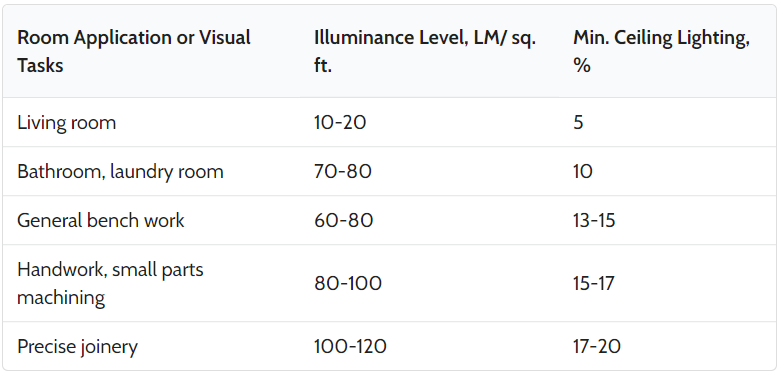
So, the required lumens for garage start with 70 Lm/sq. ft. It implies the light intensity at your workbench area. Additionally, consider your hobby. Is it precise metalworking or general cabinet-working? The light output could be a bit different.
How Do You Calculate Lumens per Room?
The lighting nature, color, and intensity are clear. Meanwhile, how to select and install suitable lighting fixtures?
Knowing your garage floor space, it’s not difficult to do. Let’s assume, it’s 600 sq. ft. (for example, 20*30 ft.). Thus, you would need 600*70 = 42,000 lumens.
This garage lighting calculator is simple and intuitive. But what about the real lighting fixtures output? A common lamp features 3,400-3,600 lumens delivery. Please, check the table to calculate the necessary bulb wattage.
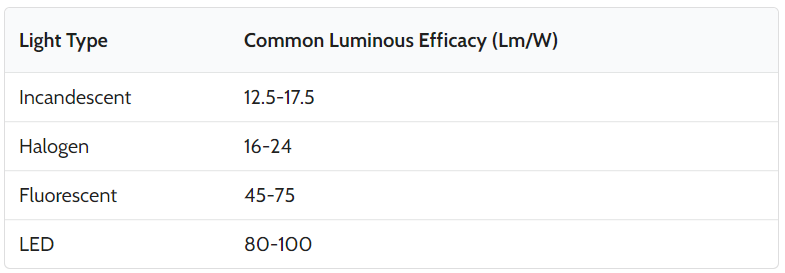
For example, the luminous efficacy of a LED lamp is 80-100 lm/W. So, you would need 12 lighting fixtures that consume about 35-40W each.
How to Position the Lighting Fixtures?
Let’s define the layout. Minimal distance in inches is to be:
- Between the workbench and the ceiling fixture = 65”.
- Betwixt the lighting fixtures = 65”-97”.
- Between the fixture and the wall = 24”-36”.
I think, now you know a lot about the workshop arrangement. You can select the lighting fixtures and install or place them. The bulbs color, light intensity in lumens per square foot and average wattage are easy to calculate or specify. Just select them and enjoy your comfortable garage environment!

Harry – this is very helpful. My research so far has suggested everything from sq footage x 20 lumens to sq footage x 150. My hunch is that a multiple of 20 is more for a living room – and I need to light a workshop, which takes me into your higher ranges. Thank you.
Mal O’Connor
Hi Mal,
I’m very glad I was able to help you!