


 Harry Brown
 It’s not a secret that lighting serves more than one (and pretty obvious) function in our everyday lives. It also helps us set the right mood, create a proper ambiance, and make the objects appear more vivid and attractive. Unfortunately, completely opposite things can happen if we choose the wrong lighting. Something as simple as lighting determines how we feel in a room – comfortable and relaxed, or uneasy and weary. And this is not just a matter of temporary discomfort. Some types of light are not friendly to our eyes and can even cause serious damage in a long run. So let’s find out which light sources are perfect for you and which should be avoided. And what light: warm white or cool white better for eyes?
First of all, let’s sum up everything that we know about artificial light. There are several common types of light bulbs: incandescent, fluorescent, LED, and halogen (less common). The light emitted by artificial sources has a wide range of possible color temperatures ranging from 1000 K to over 7000. Therefore, to choose the light that would be perfect for your eyes, you should consider the type of light source and the color temperature.
Warm White vs Cool White vs Daylight: A Comparative Chart
As we can see, the warm white spectrums, as well as neutral white, are the most favorable to your eyes. By choosing the right color temperature for each of your activities you can make sure that by the end of the day your eyes won’t be too tired. For instance, if you are thinking about daylight vs soft light for a living room, you should consider your typical activities. In case it’s mostly watching television and hanging out with family and friends, then soft light will be perfect. If your living room is also a work zone, then you might want to consider daylight. In any case, overhead lighting is not as important for your eyes as task lighting. That’s why you should be more concerned about finding the best reading lamp for eyes.
So which light is good for eyes: white or yellow? In fact, color temperature isn’t the only thing that affects your eyes. As we have already mentioned, there are several types of light bulbs and not all of them are good for your vision.
Cool White vs Neutral White
Selecting a bulb for our daily use, we consider its color temperature and brightness. Even the slightest tint difference may be important. It doesn’t work on visibility, but changes general impression you get from any object. Display of your favorite books and artworks looks a bit otherwise in a new light.
In long run, light color may affect your eyes’ health. It shouldn’t blind you. Even if it goes about a flashlight in total darkness, your eyes are to adjust to the light tint. So, what are the basic differences between neutral and cool white color spectrum? Organized information makes it clear.
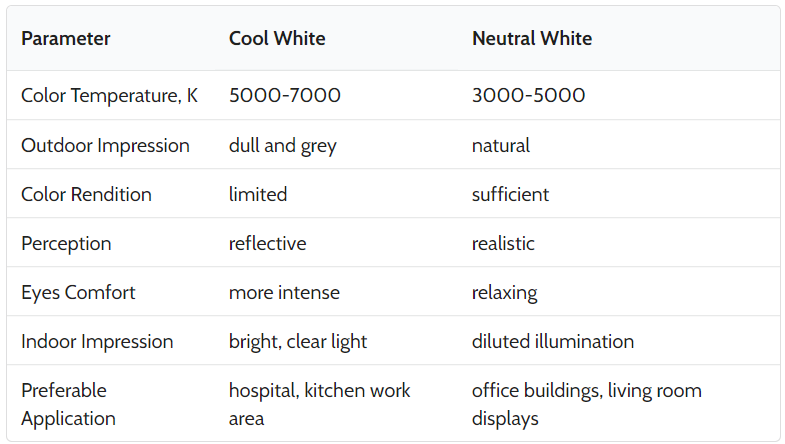
Different luminaries have dissimilar color rendition abilities: they reveal adjacent objects faithfully. Scientists compare them with natural or ideal light sources.
Benefits and Applications of Cool White Illumination
Neutral white seems to be the most natural light. It should be healthier for your eyes. A flashlight that emits neutral white light, won’t blind anybody on the road. It’s efficient in terms of energy output. But it depends on human evaluation. Color perception is personal. So, you should create a comfortable environment, according to your needs and preferences.
Cool white light is extremely bright. It’s similar to the sunlight color that is about 8,000-30,000K. Cool white is reflective, so it may be blinding if outdoor air is humid. It contains a blue light that is not beneficial to relax and sleep. But it has several undeniable advantages.
First of all, cool white light makes various rooms and areas more spacious. Therefore, lighting technicians and electricians prefer cool white illumination. They arrange it in large industrial and commercial premises, like:
- warehouses;
- shopping centers;
- hospitals;
- hair salons;
- jewelry cabinets.
Will you use cool white light at home? It suits your garage, kitchen, bathroom and other spaces. You may need advanced visibility to see all essential tools or objects. Cool white light matches modern living rooms décor and minimalistic style. If you need to accentuate your collectibles, photos or sculptures, it’s stellar. Fresh, clear glow of cool white light is beneficial. But use it only for visibility purposes, but not your comfort and relaxation.
Is LED TV Harmful for Eyes?
No activity including watching TV or working at your computer is harmful. It won’t impair your vision. Staring at the TV or computer monitor doesn’t cause permanent damage to your kid’s eyes. What is the reason for the warning?
All digital devices are sources of blue light. They include computer monitors and flat-TV screens Blue light stands out by:
- high-intensity;
- short-length, high-energy waves;
- invisible ultraviolet rays;
- often flickering;
- high brightness.
What happened to our skin when it absorbs blue light? Dermatologists state that it doesn’t damage normal skin. But as well as UV rays it might cause pigmentation, redness, and photoaging. What happens to our eyes? They have no protection from invisible rays. They can’t filter high-frequency, short waves.
It might cause eye strain, headache and blurred vision. Optometrists call it CVS (Computer Vision Syndrome). It causes dry eyes and other unpleasant symptoms. High-intensity LED bulbs may emit blue light too. Do they differ from compact fluorescent light sources? Let’s get into details.
How to Reduce the Risk of Blue Light Exposure?
Watching too much TV is harmful to your health. People that spend 2-3 continuous hours in front of a digital screen may feel fatigued. They are at greater risk of eye strain developing. Children should not sit too close to the TV screen. Otherwise, he or she could get myopia and become nearsighted.
Nevertheless, not all display technologies are harmful. Old LCD and CRT monitors have smaller viewable areas. Coming with glass screens, they cause more glare than LED displays. Additionally, they flicker too often.
Beside the technology, you can improve the situation. Do it, by selecting or implementing:
- large field of view;
- high contrast;
- low brightness;
- not too high resolution;
- comfortable ambient lighting.
Watching television in darkness is harmful. Display brightness should match your room environment. Install a small light fixture behind your TV display. Now you can enjoy watching your favorite movies easily.
All Types Of Light Bulbs
-
 Incandescent bulbs produce light in the warm spectrum. Depending on wattage they can be rather bright and the light they emit can be very clean. You can find incandescent bulbs for all types of activities. Such bulbs are usually rather comfortable for eyes, but very uneconomical.
 - Halogen bulbs. These bulbs are more long-lasting than incandescent bulbs, have a higher lumen output and the color temperature is usually higher. Even though these bulbs are applicable to a variety of indoor and outdoor lighting projects, they are losing their ground to LED lights. And you will see why.
- LED lights come in a variety of forms. There are replaceable LED bulbs that can go into regular sockets, and there are LED lighting fixtures with integrated diodes. LED lights are available in both warm and cool white, as well as neutral white. They are energy-efficient, long-lasting and safe for your eyes. The best floor lamps for reading are equipped with LED lighting.
- Fluorescent light bulbs and tubes are the sources of light that can harm your eyes and should be avoided as much as possible. The thing is that such bulbs emit UV rays, which are very bad for our eyes. As a matter of fact, fluorescent bulbs produce mostly cool white or daylight, that’s why we often associate cool light with something unhealthy. Unfortunately, fluorescent tubes are often used in commercial facilities, offices, schools, and public places, where we usually spend a lot of time.
General Conclusions and Recommendations
To sum up, there is no definite answer to the warm lighting vs cool lighting dilemma. There are tasks, for which cool light is more suitable (floor lamps for reading usually feature either neutral or cool white light). On the other hand, leisure activities and relaxation will be more enjoyable under a warm light. But you don’t need to make the “cool white vs warm white” decision once and for all. You can try different options and see what works best for you.


Add comment